".....the inexplicable ability to know what the next note has to be. Beethoven had this gift in the degree that leaves them ( other composers ) all panting in the rear guard."
" Form is only an empty word, a shell, without this gift of inevitability; a composer can write a string of perfectly molded sonata-allegro movements, with every rule obeyed, and still suffer from bad form. Beethoven broke all the rules, and turned out pieces of breath-taking rightness. Rightness--that's the word! When you get the feeling that whatever note succeeds the last is the only possible note that can rightly happen at that instant, in the context, then chances are your listening to Beethoven. "
- Leonard Bernstein
Showing posts with label composers. Show all posts
Showing posts with label composers. Show all posts
Wednesday, May 29, 2013

Tuesday, May 14, 2013
A Book Review: The New Grove Mozart
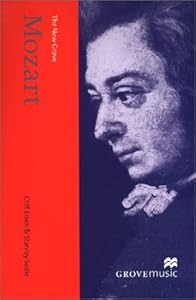
The
New Grove MOZART
Written by: Stanley Sadie
Reviewed by: Hannah DeLadurantey
We picked up this book at a library
sale a few years back, and I just got around to reading it!
Sadie takes us back to the year 1756,
the year Wolfgang Amadeus Mozart was born. This book is divided into
24 chapters, with each chapter focusing on where Mozart would have
been and what he composed during those specific years.
Overall, this book was very detailed
and helpful if you wanted to know more specifically where and when
Mozart composed certain works. Personally, I found the writing style
a bit dry, mostly dates and facts. Mozart didn't seem real, but instead, a stuffy dry man of dates and
facts. I would have liked to be transported into the 1700's, but was
sadly disappointed.
If your looking for a good informative
and intriguing story of Mozart, don't pick up this book. But, if you
in need to details on his works, be sure to read a copy of The New
Grove Mozart
Friday, April 12, 2013
A Book Review: Robert Schumann and Mascot Ziff

Robert Schumann and Mascot Ziff
Written: by Opal Wheeler
Illustrated by: Christine Price
Reviewed by: Hannah DeLadurantey
Overview:
Summery of the life and works of the renowned composer, Robert Schumann, and his cat (Mascot Ziff).
Concerning Content:
In Chapter 1
- There is mention of Schumann telling Ghost Stories. I don't believe this was necessary to move the story along, and Ghost Stories are unbiblical.
In Chapter 3
- Schumann is starving for music and good instruments after he has entered the law, so he enters a music shop and lies to the clerk, telling him that he is there to try out pianos for the Lord of Branburg. But in reality, he's there to play on the pianos to appease his own musical desires. I would not have minded this story if the authoress had explained the wrongness of Schumann's deceitfulness, but instead she said Schumann “laughed at his own musical joke”.
It is never right to wink at sin. God does not wink at our sin and neither should we. For when we disobey God's laws, we threaten the state of where our very souls will spend eternity; Heaven or Hell.
For all have sinned and fallen short of the glory of God- Romans 3:23
Jesus saith unto him, I am the way, the truth, and life: no one cometh to the Father, but by me. - John 14:6
Chapter 4
- “My good fortune!” is exclaimed by Robert because he now has his mothers very longed for blessing and permission to study music instead of the law. The Bible clearly tells us that there is no such thing as “good fortune” All things come from the hand of God.
But he said unto her, Thou speakest as one of the foolish women speaketh. What? shall we receive good at the hand of God, and shall we not receive evil? In all this did not Job sin with his lips. -Job 2:10
Chapter 5
- Fairies are said to have blest Robert and Clara Schumann's new baby girl; Marie. Fairies, like Ghost Stories are only fictitious inventions. It is God who creates and sustains life. Not fairies.
I was cast upon thee from the womb: thou [art] my God from my mother's belly. -Psalm 22:10
Thus saith the LORD that made thee, and formed thee from the womb, [which] will help thee; Fear not, O Jacob, my servant; and thou, Jesurun, whom I have chosen. -Isaiah 44:2
Thus saith the LORD that made thee, and formed thee from the womb, [which] will help thee; Fear not, O Jacob, my servant; and thou, Jesurun, whom I have chosen. -Isaiah 44:2
- “Good luck has come to us all”
Again, fortune and luck do not exist, they are “fill in” words created by man, to take away from who really brings good things to us; God, the maker of heaven and earth.
Providence would have been a better word, so I think I'll cross the luck and fortune words out of this book and write in Providence.
Praiseworthy Content:
Chapter 1
- Robert is disrespectful to an elder, and clubs him on his back with a stick. But, it doesn't end there! Robert's father, August, sees this incident, and Robert is duly punished for the unkind act
Chapter 5
- Throughout this whole storybook of Robert Schumann's life, you read of the tension between Mother and Father Schumann's desires for Robert. Father Schumann encouraged his son in music, but Mother Schumann didn't. So, after Father Schumann dies, Mother Schumann requests, with great urgency, that Robert give up music and turn to the law. Robert in response to his mothers request, is shown to have not agreed with his mother's wishes, but willingly puts himself under them and obeys. Later in the story, Robert petitions his mother to allow him to study music once again, and is granted it.
Honor thy Father and Mother which is the first commandment with promise. -Ephesians 6:2
Chapter 4
- Robert's honorableness is asking Mr. Weik permission to marry Clara Weik.
Chapter 5
- Robert Schumann was a very thoughtful man, and multi-generational in his vision. He composed in a very forward thinking and persistent way, all manner of compositions for his collection of; Children's Pieces that were written for his own dear children.
Concluding Thoughts:
Scattered throughout the whole book, Opal Wheeler weaved in various other composers names and concerts that Schumann gave. It was intriguing to see who crossed paths with Schumann, who influenced him and who he influenced.
Scattered throughout the whole book, Opal Wheeler weaved in various other composers names and concerts that Schumann gave. It was intriguing to see who crossed paths with Schumann, who influenced him and who he influenced.
The beginning mentions Napoleon Bonaparte and a few other political things that would have been going on during Schumann's life. I liked that you got a little bit bigger of a picture of what was going on during that time period and who else was composing music as well.
Like the other book Wheeler wrote on Bach, this book contains lots of abridged compositions that little ones can use to tinker around on the piano.
In the end, Robert Schumann and Mascot Ziff will still find itself on Hannah's bookshelf, give or take a few changes to its typeset:)
Like the other book Wheeler wrote on Bach, this book contains lots of abridged compositions that little ones can use to tinker around on the piano.
In the end, Robert Schumann and Mascot Ziff will still find itself on Hannah's bookshelf, give or take a few changes to its typeset:)
Friday, March 15, 2013
Johann Sebastian Bach: A Man Tenacious for Excellence
Written by: Hannah DeLadurantey
He was a teacher, performer, and composer; father, husband
and friend. But most importantly, Johann Sebastian Bach believed on and trusted
in the everlasting Father, the Prince of Peace; Jesus Christ, Savior of the
universe.
J.S. Bach’s faith in God is typically, very willingly
notated in many authors accounts of Bach’s work and life, but it is just simply
that; notated. Quite frequently Bach’s faith is only mentioned as something to
accompany his other various “hats” that he wore during his life, or just a little
marchino cherry on top of the ice cream sundae. But was that all it was to
him, a “hat” to take on and off depending on who he was working for. Maybe it
was something he turned on and off depending on whether or not it suited his
need for the moment? Or was Bach’s faith a scheme for money? Prestige? Was it only
feigned humility before God that Bach’s began his scores with JJ (Jesu Juva “ Jesus Help”)? And did
he end the scores with SDG ( Soli Deo Gloria “To God alone the Glory”), just to
cross his T’s and dot his I’s?
Indeed, it would
be blasphemous if this was true, but I think we can safely know that it is not.
Bach was not into “religion” for money or popularity. No, rather Bach had the
most awesome fear for God, a fear that drove him to strive for the utmost
excellence in all he put his hand and mind to. Below are a few quotes that I
believe will suffice in proving Bach’s honest, godly character.
1“Near 1 Chronicles 25 (a listing of Davidic musicians) Bach wrote,
‘This chapter is the true foundation of all God-pleasing music.’ At 2 Chronicles 5:13 (which speaks of
temple musicians praising God), he noted, ‘At a reverent performance of music,
God is always at hand with his gracious presence.’”
“
The final reason for music should be none else but the for the glory of God and
the recreation of the mind ”
-J.S.
Bach
"Just practice diligently, and it will go
very well. You have five fingers on each hand just as healthy as mine."
-J.S. Bach
For Bach, music was written for the glory of God alone. The
Cantata’s, Concertos, Arias, and Fugues were not written to puff up Bach’s own
ego, but for the exaltation of God’s most precious and holy name; so that every
knee would bow and every tongue would confess that Jesus Christ is Lord. Bach
revealed to us, through his diligent efforts, the “why” behind our various
vocations, careers, and talents: They are for the glorification of God and the
benefit of others, not for ourselves.
March 21st is Johann Sebastian Bach’s 328th
birthday, so there are many opportunities for us to attend concerts dedicated
to this genius. We can read many accounts of his astounding compositions as well
as perform some of his breathtaking music. We must be on our guard that we are
not being deceived by what the world tells us about Bach. It’s easy for us to
fall into the trap of thinking that Bach’s gift was just natural and specific
only to him. “There will never be anyone as good,” we say, or “he was just
gifted”.
Yes, I must
concur that Bach was very skillfully gifted (by the grace of God), but I also
think that Bach was a very diligent and hard worker. He didn’t give up; he was
persistent and tenacious for excellence. Nothing less then the best would do.
Was he a perfectionist? I don’t think so, because if he were, we wouldn’t have
half as many works of his as we do today. Is Bach the best to be had, and could
there ever be another composer to surpass him? There may not ever be another
“J.S. Bach”, but that doesn’t mean we settle for less. The key to Bach’s
greatness wasn’t his teachers, or instrument; it was/is his fear of God. Bach did his
best; and left the rest up to God. Bach held to the standard of truth, God’s
Word; and God blessed him for it. Let us pray that our legacy may be the same.
“The world does not need more Christian
writers-it needs more good writers, and composers, who are Christians. And when
we produce art that is really good, art that reflects a biblical world view,
its richness will endure through the ages.”
-C.S. Lewis
1 Johann Sebastian Bach from Christianitytoday.com
Subscribe to:
Posts (Atom)
